

Inspiration of the novel Morning of a Crescent Moon
October 2023, Virden, Illinois, 630 North Dye Street
No trace of the mine remained, unless you knew where to look. And John Alexander knew where to look.
I came to the lot with him and his wife, Jeannie, who remained in the car several yards away. They own Books on the Square in Virden, Illinois, where John collects the town’s history.
As the clock struck six, the air grew golden, and my shadow grew long. A cool breeze stroked the grass of a seven-acre lot bounded by houses on three sides and railroad tracks to the east. I zipped my jacket, thinking I never would have suspected I was standing over an old coal mine.
Just as I thought this, John pointed a finger toward something hidden in the grass: a metal plate, indicating the location of the mine’s main shaft. A sense of uneasiness came over me—I knew what lay beneath. We read the metal plate.
DEPARTMENT OF MINES AND MINERALS
STATE OF ILLINOIS
DO NOT DEFACE
VIRDEN NORTH MINE
MAIN SHAFT
20 FT N–NE
SEALED JULY 86
I walked over to a depression in the ground, picked up an old piece of wood and a fragment of brick, and called back to Jeannie. “Call 911 if the ground gives way and we fall into the mine.” She didn’t think it was funny.
At a later date, I learned that the state had filled the shaft with rocks and ten feet of cement, so there was little chance of my falling in. Yet in many ways, I did fall down a shaft that day. Standing beside the town’s historian, I began mining for information on the Battle of Virden, which took place in 1898— one of our country’s deadliest labor battles.
Researching history
I learned that in the late 1800s, the Chicago–Virden Coal Company operated the largest producing coal mine in Illinois—the mine that lay dormant under my feet. The main shaft reached down over three hundred feet into the earth. Tunnels six to seven feet high radiated out from the shaft in all directions, a result of miners extracting the ancient remains of primitive plants and animals that lived hundreds of millions of years ago. The combustion of those ancient living organisms fueled society into the twentieth century.
A familial connection
Despite the many years and layers of cement that distanced me from the history, I felt a familial connection to the North Virden mine. I pictured my father, over seventy years earlier, riding an empty railcar down this same slope toward the mine’s tipple, where the cars would be loaded with coal before joining the main tracks. A horse named Buck, the size of a Clydesdale, would get the car moving. After that, my dad would unhook the horse and let gravity take over. This was around 1948 or 1949, fifty years after eight miners lost their lives.
My father worked at the mine for a couple of years before being drafted during the Korean War, but my grandfather worked at the mine for seventeen years, from 1942 to 1959. Dad once told me that he woke up one January morning in 1942 to find his father cleaning his work shoes. My dad asked his mother why he was doing that, and she said, “Oh, he’s starting a job at the mine!” For a decade during The Depression, they had been scraping by—my grandmother cleaning houses, my grandfather working on Public Works projects, and my father selling garden vegetables from his coaster wagon until he could get a paper route. My grandfather’s first day at the mine was greeted with optimism and excitement.
A professional connection
Beyond my family connection, I also felt a professional one. The operator of the mine in 1898 arranged to bring in cheaper labor, unsuspecting Black workers from Alabama. They were told that the Virden miners were off fighting the Spanish-American War and that the mine was short-handed. In reality, the operators had plenty of local workers to hire; they simply outsourced for a class of workers who would accept lower wages.
In my job as a chemist, I had witnessed the same pursuit of less costly labor. The pressure on businesses to maximize profits by lowering costs is part of the capitalist system. I watched the company I worked for add jobs in India and China while laying off workers in the U.S. and Europe. One of those lay-offs was me.
In my case, I was an educated professional who had the ability to work elsewhere. But I wondered what those relatively poor, working-class miners felt about having their work and the risks they took every day devalued. And what were they risking by confronting the mine operator and taking a stand?
Deciding on historical fiction
To answer those questions, I had to imagine what the town of Virden was like in 1898, which meant doing a lot of research. Bringing the wood and brick from the mine home with me, I studied all the published articles I could find on the Battle of Virden. I dug through old newspapers and squinted at many pages of microfilm. Slowly, I came to understand the town and its people. Those who had the money were taking vacations and traveling all over the country by train. Cars were not in use, and roads were not paved, but there were wooden walkways. The miners had a company store, but they were paid in dollars and not company script.
Virden was a business center and a farming community as much as, if not more than, it was a mining town. The miners needed to maintain a living wage so they would not repeat what they had left behind in the old country. I was surprised at how invested I became in this town and its people of 1898.
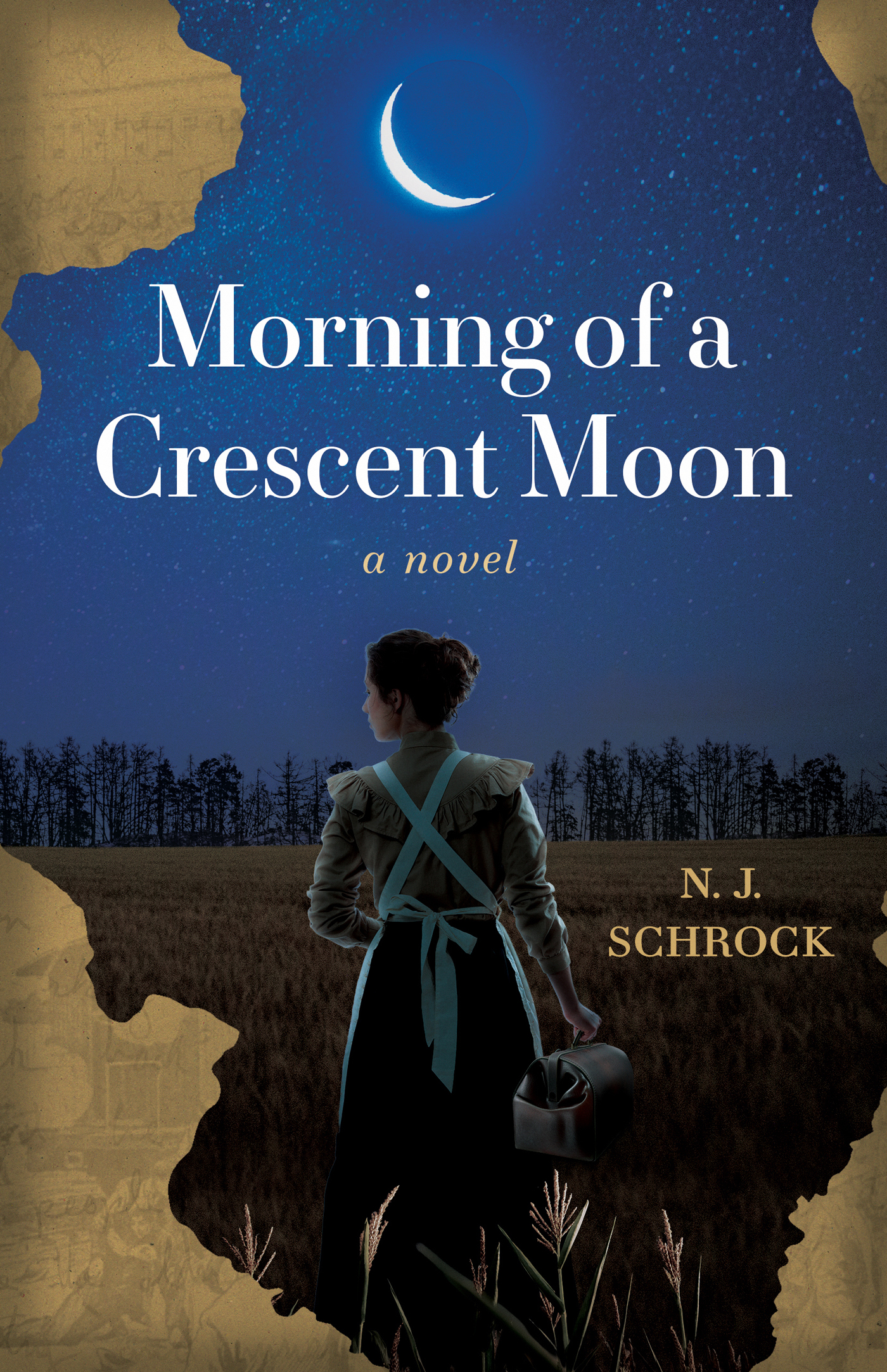
As I collected information, I knew I had to write the story of their struggle. But how? I decided that historical fiction would be the best genre. It allowed me to imagine the hearts and minds of the people who lived through these times while keeping the historical events as accurate as possible. I wanted readers to get to know the people and the town so they could later appreciate what was at stake when these laborers decided to take a stand and fight for both living wages and safer working conditions. Thus, Morning of a Crescent Moon came to be.
The meaning behind the historical fiction novel
I often look at the photo I took that evening in October 2023, when I stood where the mine once stood. My shadow stretches eastward toward the farmer’s field beyond the railroad tracks—the field where six miners died on the day of the battle and two more soon after from their wounds. But their sacrifice brought change. The miners succeeded in getting the contract they wanted, and the battle served as an example for future labor activism.
Those miners, too, cast long shadows that reach into the present. I hope Morning of a Crescent Moon readers come away convinced that the fight for living wages and safe working conditions is never over.
Who is N.J. Schrock?
Nancy Peacock Schrock, Ph.D., grew up in Virden, Illinois, where her father and grandfather worked in the Virden North Mine. Drawing on family history, research, and local archives, she reconstructs the pivotal 1898 labor battle that strengthened the United Mine Workers of America. A retired corporate researcher, she holds degrees in chemistry and English, has published across genres—including the novel Incense Rising—and now teaches online chemistry. She lives in New Mexico with her husband and two dogs. Read more about Nancy’s historical fiction at her website.
We hope you enjoyed this N.J. Schrock guest post. Stay tuned for more conversations with Indigo River Publishing authors.
Explore More Resources
For more author interviews and guides for writers, visit our Blog & Resources page.