
With increased advertising efforts and marketing in the digital space, it is more difficult than ever for a brand to break through. However, it’s not impossible. The key is delivering on promises.
Seventy-one percent of consumers doubt that brands will follow through on their promises. Meaning, there is a clear gap in what brands are communicating and what consumers are receiving.
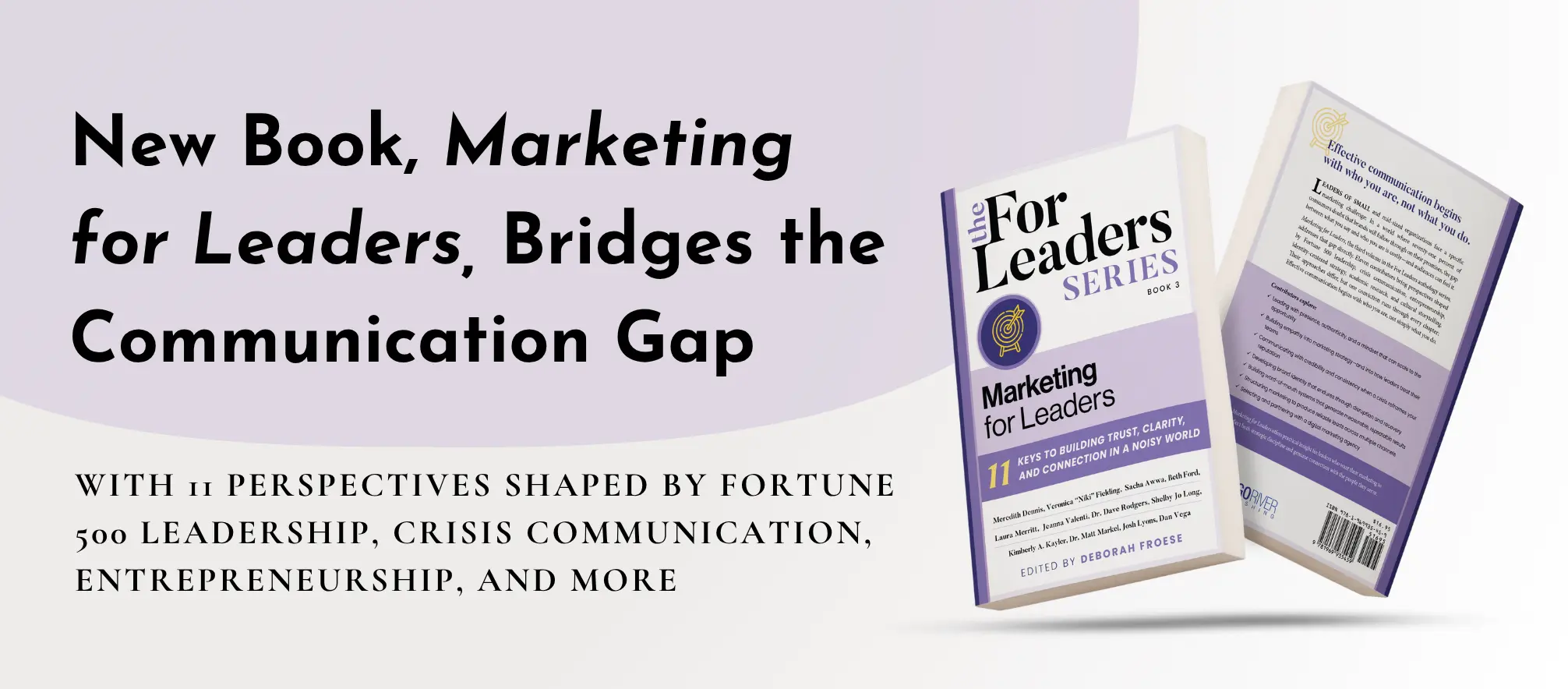
A new book in the For Leaders series, Marketing for Leaders, explores how brands can bridge that gap. Eleven contributors come together, bringing their experiences in crisis communication, entrepreneurship, identity-centered strategy, academic research, and cultural storytelling to teach business leaders how they can break through the noise of today and communicate clearly with customers.
The following is the introduction, which precedes the book’s thought-provoking chapters.
Excerpt from Marketing for Leaders
Written by Deborah Froese:
We’ve all done it. An online ad or news post caught our attention and, for a split second—until we recognized it as a bot or a deep fake—we believed it. Even “real” products can be misleading. About a year ago, I subscribed to a basic online teleprompter program that had good reviews and worked well at first. Still, when a problem came up, there was no response to repeated emails requesting support. A few months before my subscription expired, the program vanished.
That’s the world we live in today—fast-moving, unpredictable, and shaped by online tools and platforms that evolve faster than most of us can track. Leaders must make decisions in real time, often without complete information, while customers, employees, and stakeholders grapple with relentless information overload. For small and mid-sized business owners and entrepreneurs—those balancing limited resources, tight timelines, and a constant flow of operational demands—the challenge is especially intense.
Marketing for Leaders, the third volume in the For Leaders anthology series, enters this environment with a clear purpose. It does not offer a single formula, a prescriptive framework, or a universal strategy. Instead, it gathers insights from contributors who are deeply attuned to marketing’s nuances. Their vantage points span Fortune 500 leadership, crisis communication, identity- and presence-centered leadership, strategic marketing, entrepreneurship, creative strategy, academia, and cultural storytelling. This diversity is intentional. Together, these voices reflect the real breadth of what modern marketing requires.
Despite the differences in approach, one truth emerges again and again: Effective communication begins with who you are, not just what you do. In a world saturated with content, audiences respond to clarity, emotional resonance, and values they can believe in. Recent research reinforces this reality:
- Seventy-one percent of consumers doubt that brands will follow through on what they promise.
- Eighty-two percent seek brands that align with their personal values.
- Eighty-six percent say emotional needs influence their buying decisions.
- More than half of consumers are willing to switch to a competitor after just one negative or impersonal experience.
These numbers underscore the challenge for leaders of small and mid-sized organizations: Trust is fragile, choices are abundant, and audiences are increasingly skilled at filtering out anything that feels insincere. The path forward isn’t louder messaging or more aggressive tactics; instead, it’s communication rooted in credibility, empathy, and identity.
As an editor and communicator, I’ve seen how difficult it can be for leaders to articulate who they are in a crowded digital world. Yet it is precisely this work that sets lasting brands apart. Leaders who communicate with clarity and integrity build relationships that endure beyond any single platform, campaign, or trend.
The contributors to Marketing for Leaders illuminate this truth from many angles. Some offer research-driven insights; others draw from crisis-tested leadership and moments of personal transformation—experiences that reshaped how they understand communication and influence. Each chapter stands alone, and together they reveal a shared understanding: Marketing is relational work. It demands presence, self-awareness, and the courage to lead with values—especially in small and mid-sized organizations where leaders cannot disappear behind departments or hierarchy.
You do not need to read this anthology in order. Begin wherever interest pulls you—whether you’re addressing a mindset shift, seeking clarity, responding to a crisis, strengthening your foundation, or refining your structure. Let the contributors meet you where you are.
As you move through the pages, you may notice a common theme: Marketing is not simply a set of tactics. It is a discipline grounded in how well you understand people—your customers, your teams, and yourself. Strategy and execution matter, of course. However, enduring marketing grows from emotional honesty, clear identity, organizational alignment, and communication that reflects who you truly are.
In a digital environment crowded with competing messages and manufactured personas, the brands that endure are the ones that communicate—and behave—in ways their audiences can trust. That work begins with you—but you aren’t alone. The insights ahead offer guidance and practical pathways you can adapt to your leadership style, business size, and marketing needs.
Wherever you start, my invitation is simple: Explore with curiosity. Let these voices accompany you as you build relationships, make decisions, and shape the future of your brand with clarity and integrity in a world that depends on both.
Marketing for Leaders © 2026 by Deborah Froese (Editor). Used with permission from Indigo River Publishing.
Marketing for Leaders is available on Amazon, Barnes and Noble, Books-A-Million, and Bookshop.org.